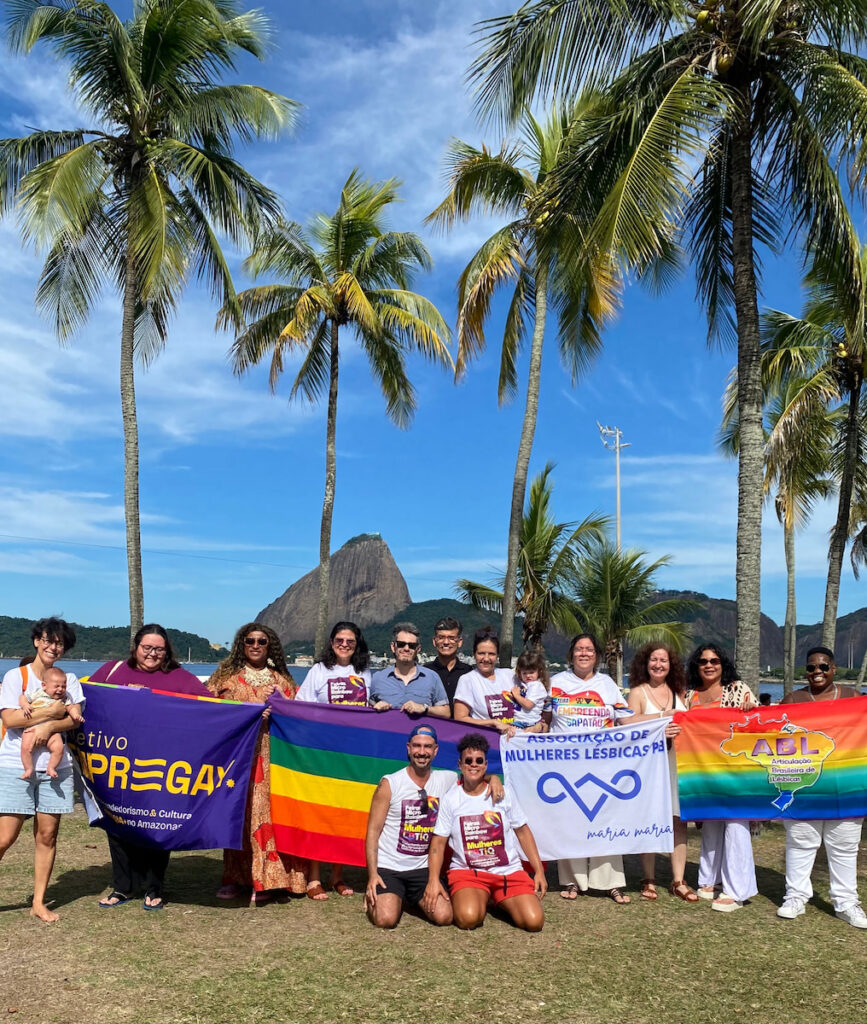

The first phase of the Micro Rainbow Fairs for LBTQI+ Women project ran from August 2025 to May 2026 with funding from the Potluck Fund. Aiming to strengthen LBTQI+ women’s small businesses through capacity building, training and small business fairs, our Brazil team delivered an innovative fair-production training to 24 LBTQI+ women from across the country. The goal of the training was to support participants in developing a business plan that would enable them to implement a small business fair for their own communities.
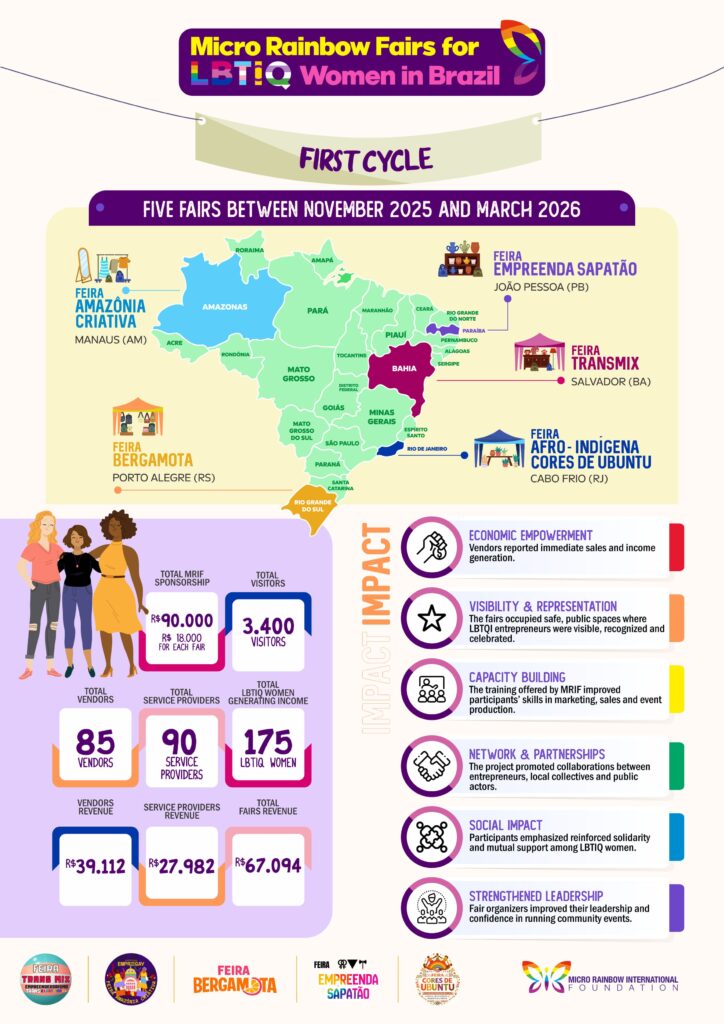
At the end of the training, 13 workplans were presented and five participants were awarded sponsorship and mentorship from our Micro Rainbow Brazil team to support them in organizing their fairs in different regions of the country: Amazônia Criativa (AM), Bergamota (RS), Empreenda Sapatão (PB), Feira Afro‑Indígena Cores de Ubuntu (RJ) and Feira Transmix (BA).
Since Feira Amazônia Criativa was the most successful and generated the highest revenue, a case study was produced highlighting the organiser’s journey with Micro Rainbow since 2022 and presenting the fair’s outcomes in detail. Read the full story here.
MAIN RESULTS
All fairs were developed in partnership with local leaders and entrepreneurs, demonstrating that economy and resistance go hand in hand. The results were striking: a total of 3,400 visitors, generating nearly R$40,000 in sales for 85 exhibitors, plus almost R$28,000 in contracts for 90 artists and service providers, thus generating more than R$67,000 in direct income for 175 LBTQI+ women entrepreneurs.
QUALITATIVE IMPACT
- Economic empowerment: vendors and service providers reported direct income generation, both from strong on-site sales and from contracts and performance payments. Organisers prioritised hiring LBTQI+ women for all fair roles, surpassing the initial target by 75% (from 100 to 175 women impacted), despite one fair being cancelled.
- Visibility and representation: the fairs occupied safe, high-profile public spaces — such as central squares, theatres and tourist sites — where LBTQI+ entrepreneurs were made visible, recognised and celebrated. This was an important political and economic achievement for leaders and their communities. Fair organisers also reported an increase in their social media engagement due to the fairs’ coordinated promotion.
- Capacity building: the training delivered by MRIF enhanced participants’ skills in marketing, sales, event production and finance, providing essential planning and management tools to support the delivery and sustainability of their fairs and other initiatives.
- Networks and partnerships: the project fostered collaboration among entrepreneurs, local collectives and public actors, securing partnerships and opportunities beyond the fairs as well as opening space for grassroots leaders and organisations to produce events and generate income for their communities.
- Social impact: participants reported increased solidarity and mutual support among LBTQI+ women, many of whom previously lacked spaces for connection, visibility or the income needed to cover the costs of taking part in a business fair.
- Strengthening leadership: fair organisers improved their leadership and visibility within local/regional entrepreneurship and cultural spaces, receiving requests and invitations to run future events from both exhibitors and public partners. Project coordinators also gained more confidence and autonomy, allowing them to take a more active lead in the project, tackle challenges, and propose solutions.
More than markets: vehicles for LBTIQ+ economic empowerment
“Micro Rainbow is the only organisation that genuinely supports small entrepreneurs, as it should,” emphasized Thalyne Malta at the in-person meeting— a powerful endorsement of our approach. We learnt that boldness is not merely permitted but necessary. Supporting fairs from their formative stages proved more ambitious and demanding than anticipated, yet it delivered invaluable gains for our work. Beyond income generation and leadership strengthening, this pioneering initiative has seeded new social technologies to promote LBTQI women’s entrepreneurship in Brazil.
Participants frequently praised our team’s kind guidance and supportive presence; they discovered that the Micro Rainbow Brazil name itself conveys security to their fairs and legitimacy to public authorities and partners. Beneficiaries recognised they deserved international investment and used that agency to confront lesbophobia, transphobia and misogyny, delivering their events with competence and determination.
More than targets met, we co‑created spaces of visibility, belonging and mutual support for LBTQI+ women — safe platforms where leaders and entrepreneurs were recognised, strengthened and valued. Despite storms, funding withdrawals and other challenges, the fairs proved to be more than markets: they are vehicles for economic empowerment and leadership consolidation for LBTQI+ women in Brazil.
Due to the project’s success and great visibility of the fairs, funding was secured to organise five additional fairs between June and August 2026, with the aim of creating work and income opportunities for another 100 LBTQI+ entrepreneurs in the country.