
Mica Ferraz’s journey with Micro Rainbow International Foundation began well before our fairs project in Brazil. She had already taken part in our accelerator programme, seeking tools to develop and grow her business, Macuco Brewery, which celebrates its 10th anniversary in 2026.
That first experience gave her practical knowledge she could apply directly to running a business. Strategy, positioning, planning, financial sustainability, and growth stopped being abstract concepts and became part of the everyday decisions she made at Macuco.
Macuco also brought her into the world of fairs and markets. She had taken part in events both as a vendor and as a co-organiser, so she knew first-hand what it was like on the ground: producing goods, transporting them, setting up stalls, welcoming visitors, making sales, and building connections. She also understood the responsibilities involved — and the many unexpected challenges that come with organising this kind of event.
What she had not yet experienced was leading the creation, design, planning, and delivery of an entire fair. That opportunity came through Micro Rainbow Brazil fairs project for LBTIQ+ women. Being selected as one of 20 women for the fair-production training programme was already meaningful to her because she could see how the knowledge would connect with her own experience.
“Alongside the technical content, we had incredible mentoring sessions where we could discuss our projects, questions, challenges, and concrete possibilities. One of Micro Rainbow’s greatest strengths, in my view, is that its team genuinely shares knowledge, supports the process, and reinforces learning along the way. You don’t just receive information and then have to figure out on your own how to put it into practice. There’s dialogue, listening, ongoing support, and a sense of collective creation that strengthens not only each participant but the whole community.”
And the opportunities didn’t end there…
Feira Bergamota
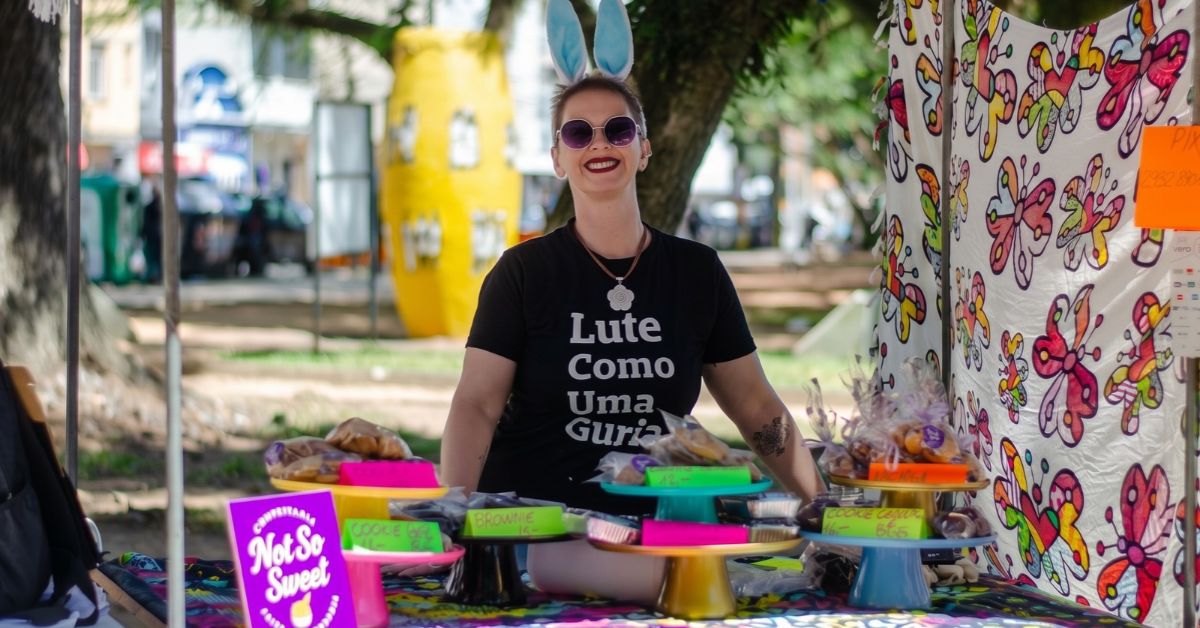
Mica was one of five women awarded funding to bring their fair projects to life. That is how Feira Bergamota was born in Porto Alegre, in the state of Rio Grande do Sul.
Holding a fair at that time had particular significance for her. Porto Alegre was still facing economic hardship, less than two years after floods devastated communities across the state. Many small-business owners had lost inventory, equipment, workspaces, income, and the ability to invest. Even those who had not been directly affected by the floodwaters were part of a local economy still trying to recover.
As a vendor, Mica already knew how much an event could mean to an entrepreneur. A good day’s sales could provide money to buy new materials, pay expenses, or keep investing in a business. But there are also benefits that don’t immediately show up in sales figures: new customers, publicity, contacts, partnerships, and opportunities that may emerge weeks or months later. In that context, the opportunity provided by Micro Rainbow became even more important.
“I started to see a fair not just as an event, but as a practical way to generate income, circulate money, and strengthen small businesses and the community.”
With Bergamota, Mica had the chance to see all of this from a new perspective. She had to consider who would exhibit, whom the fair would reach, what venue to use, how to shape the communications, programme, visual identity, logistics, budget, and partnerships — and, above all, the purpose behind each decision. It was an intensive exercise in planning, leadership, coordination, listening, and problem-solving. Having been a vendor herself, she also brought an understanding of exhibitors’ needs.
“Putting the fair together was also a very personal and meaningful experience for me. My wife, Cecília, worked on the project with me. Sharing the process and seeing our skills come together to turn an idea into something with its own name, image, and personality was incredibly special.”
The results spoke for themselves: Bergamota generated nearly R$15,000 in direct income for 25 LBTIQ women, including vendors and service providers.

Outra Feira
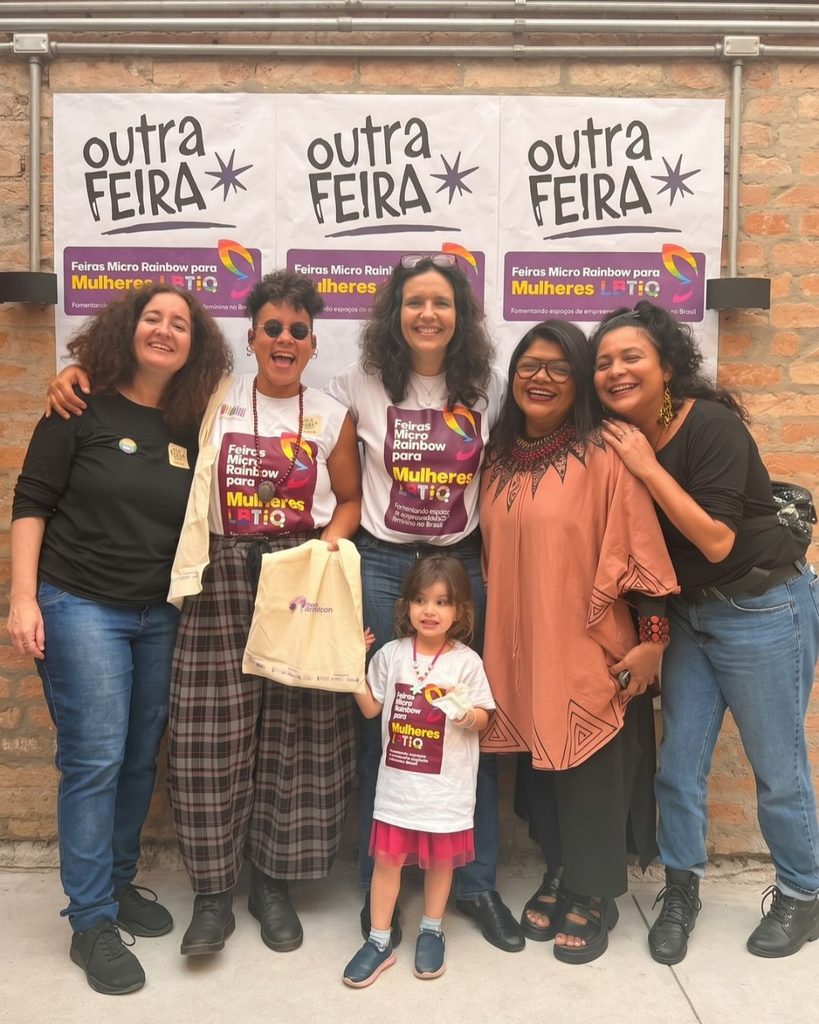
The success of the first cycle of fairs led to a second cycle, with five more fairs. Mica was the only participant selected for both cycles.
“I was incredibly happy to be selected again. This time, in addition to what I’d learned in the training and mentoring sessions, I’d have the chance to put the lessons from Bergamota into practice.”
The new cycle brought a significant change: the location. In the short time since the first fair, Mica had moved to São Paulo and was now facing the challenge of organising her second fair in the largest metropolis in the Americas.
But she understood that “replicating doesn’t mean copying.” Bringing a project to a new place wasn’t simply a matter of repeating what had worked before. It meant “recognising what could be improved, listening to the new community, and adapting what you’ve learned to the reality of the people who live there.” True to its name, Outra Feira — “Another Fair” — needed an identity of its own.
With that in mind, Mica brought together entrepreneurship, art, music, food, and independent production, while keeping a central goal: creating space and opportunities for 33 more LBTIQ women entrepreneurs. Together, they generated R$18,000 in direct income, reaching a higher revenue than her previous fair.
“At Bergamota, I was learning what it meant to take on a leadership and organising role. By the time I organized Outra Feira in São Paulo, I could make decisions with more experience, structure, confidence, and purpose.”
Mica came to understand that a fair is much more than a group of people showcasing products and services. It sets an entire chain in motion, creating a genuine economic ecosystem. When a fair takes place, money circulates — and so do people, knowledge, opportunities, connections, and ways to strengthen the community.
That is why, especially during difficult economic times, supporting a fair can mean much more than funding an event. It means activating that network. The impact doesn’t end when the fair closes.
Mica’s own journey shows this. First, Micro Rainbow gave her tools to think about growing Macuco. Then it helped her grow as a lesbian leader through organising two fairs that directly impacted 58 other women. The process also changed her understanding of leadership:
“Leadership isn’t just about organizing, taking responsibility, solving problems, and delivering results. It’s also about creating the conditions for other people to access opportunities that go far beyond what they earn that day. It means supporting not only income generation, but also autonomy, networks, confidence, belonging, and a stronger community.”
The knowledge didn’t stop with Mica — through her it grew and spread. And perhaps that is the most powerful part of her story with Micro Rainbow Brazil.
Written by Mica Ferraz